Tuesday, June 21, 2011

Patriots and Politics


License plates in European Union countries are a far cry from those in the USA.  You won't come across 37 distinct personalized plates per country promoting such interests as college alumnis, professional sports teams, state mottos, tourist landmarks, anything and everything.  EU plates have a circle of stars and a letter code of the country beneath it: F (France), GB (Great Britain), PL (Poland), E (Espagne), IRL (Ireland), TR (Turkey), CH (Switzerland), etc.  Some are more obvious than others.  I recently came across the above plate in Ax-les-Termes:  OC for Occitania.  Oc is a linguistic region rather than a distinct country defined by political borders.  But it is very political in this region, and you will see numerous stickers on vehicles displaying Oc patriotism.  Since OC is not an actual country, someone has altered this license plate.


Another highly charged political issue in the Midi-Pyrenees is the re-introduction of bears and wolves. For pretty much the same reasons that grizzlies and wolves find themselves in the hot seat around Yellowstone National Park, Pyreneean sheep ranchers contend that bears and wolves threaten their livelihood.  "Neither bears nor wolves" is frequently painted on the roads, this one headed up the Plateau de Beille.


Baaaack in Montana

On the motorway near Tarascon the other day a little Citroen utility wagon passed us.  Nothing unusual there, except when we noticed the cargo.  Then I looked closer and counted four sheep in the back seat and a man and a woman up front.  All in a vehicle about the size of a Toyota Rav4.  It was just like being back in Montana, goin' on a "double date".  And speaking of double dates and Montana, check out http://www.duckboy.com/ for hilarious postcard interpretations of interactions between man and nature.

Come with Me on My Morning Walk


Most mornings I walk out our door, cross the stone bridge, past the chateau and 
head down the tree lined lane.  I turn the corner and get
another great view of the chateau, this time with the tennis court.  The pool is just out of sight on the right.  I contunue on
up a gentle hill, through another tree lined lane.
I continue on through more trees until suddenly, the little road breaks out of the trees,
and I have this beautiful view of the village of Leran.  In the distance are the eastern reaches of the Pyrenees.
On this particular  morning, the hayfield had just been mowed but hadn't been gathered up into large round bales.
At the top of the hill I take a left and head down a little grass path used by walkers, bicycle and horses.
The path takes a left at the River Touyre,
which flows under a small footbridge,
and back to the beginning where it flows beneath the old stone bridge near our house, and I'm home. (Click on 'em to enlarge 'em.)

Monday, June 20, 2011

Are You Feeling Stressed and Irritable?


Then play this short video and perhaps it will help you relax.  This little video is taken at the end of the paved road on the Plateau de Bielle where the Tour de France will finish on July 16.  There are cross country ski trails, dog sled trails and hiking trails leading off from the little station at the summit. The ringing noise is the cowbell that each cow wears so that the responsible party can find them (I couldn't decide on the correct term; shepherd, cowherd, cowboy, rancher).  When you are close enough to them, the sound of the cowbell is deafening. 

Sunday, June 19, 2011

Hats Off as Traditional Beret Fades out of French Fashion

By Philip Delves Broughton in Oloron Sainte Marie
02 Aug 2002

Farm workers, philosophers and gamines winking astride their bicycles made the beret an icon of French life.

Whether worn low over the brow, in the style of Basque shepherds, or aslant, like Jean-Paul Sartre, tipped back like a carefree Breton sailor or straight like a Resistance heroine, the beret became a symbol of France.

But now, it has all but vanished from everyday life and the remnants of the beret industry are struggling for survival.

Forty years ago, there were 15 beret factories in Oloron-Sainte Marie, France's beret capital, a picturesque town in the foothills of the Pyrenees. Now there is just one, employing 85 people, mostly women, churning out berets for armies from New Zealand to South America, and a few for the domestic market.
But even the foreign markets are drying up. The Cubans, for example, now use cheaper manufacturers in the Far East. Their last big order, for 20,000, came in 1997 for the 30th anniversary of Che Guevara's death.

A beret bought in a a souvenir shop in France has probably been made in China. It will be very different from the real, hand-crafted French beret but few seem to care.
"We suffer from the savagery of fashion," said Bernard Fargues, the head of Beatex, the last beret maker in town. A thin, lugubrious man, M Fargues is all business and wears a beret only for special occasions.

In Bearn, close to the Spanish border, the beret is a symbol of rural independence, both French and Basque. The earliest record of it is in 13th century stone carvings on a local church. Shepherds found it warm and versatile, as it rarely blew off in mountain storms and could be pulled over the eyes at night. It became known as the beret basque.

Its popularity surged in the late 19th and early 20th centuries in France and soon the fashion industry adopted it, making it a popular item for American women in the 1920s. Then came the British army, followed by the Americans, and the Boy Scouts.

By the 1950s, the beret was everywhere, on children and celebrities, such as Che, the jazz musician Thelonius Monk and the artist Picasso. There was even a French cartoon superhero, SuperDupont, who wore a beret and striped shirt and carried a cockerel.

"Urbanisation ruined everything," said M Fargues. "At first when rural people moved into the cities, they carried on wearing the beret. And the intellectuals began to wear it as a symbol of solidarity.

"They were cheaper than the formal hats that the bourgeois wore. But then people stopped wearing berets in the towns because it came to be seen as a sign of a provincial, a peasant. Beret wearing declined in proportion to the rural exodus."
French newspaper cartoonists still use the beret as shorthand for pompous jingoism or nostalgia in politicians. Older men in rural communities, especially in the south, still wear them.

But Beatex and the only other French maker, Blancq-Olibet, in the nearby town of Nay, have had to lay off workers in recent years. Blancq-Olibet has set up a small museum to try to boost interest in the product.

"We've thought about asking for government help," said M Fargues. "It hasn't yet come to that, but it's not easy. The Americans are particularly protective of their beret makers, which deprives us of a big market."  His factory produces 700,000 berets a year, of which just a tenth are the traditional berets basques.
Among the French, though, the beret seems to have retreated to its rural domain, patiently waiting for its next turn in the spotlight.

Monday, June 13, 2011

Hot Hot Air

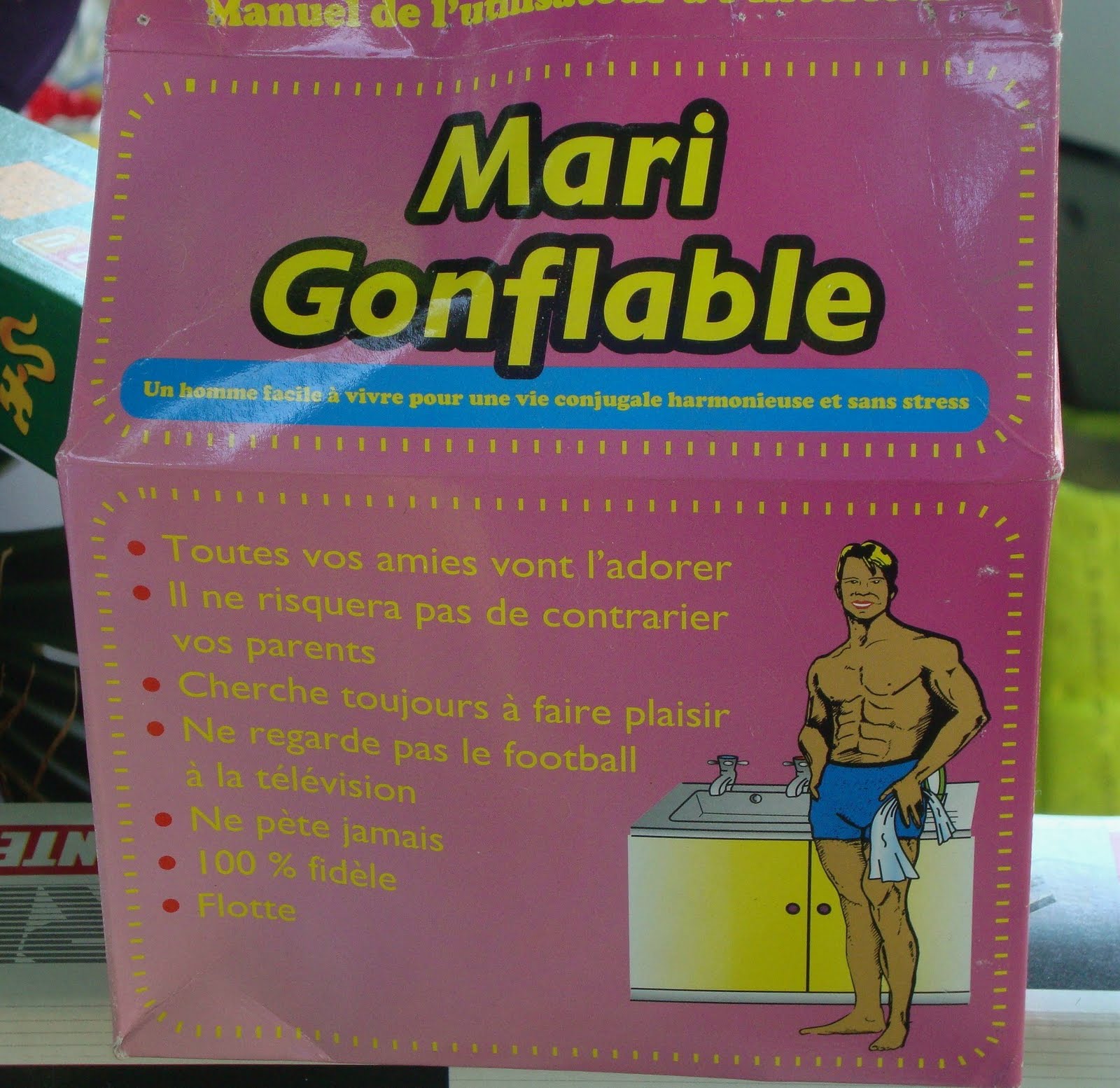
Sometimes at a vide grenier, I see an item that isn't just the typical bed linens or baby clothes or old tools. Yes, sometimes there really are those one-or-a-kind things that deserve notice. Such is the Mari Gonflable, the inflatable husband. As the packaging highlights, M. Gonflable possesses superior qualities:

All your friends will love him. No danger of annoying your parents. Always tries to be pleasing. Doesn't watch football on TV. Never farts. 100% faithful. and...floats!


If you are interested in acquiring 1 meter of pure happiness, then Mari Gonflable just might be your dream partner. I did not take M. Gonflable out of the box to determine exactly what dimension the 1 meter referred. In the interest allowing others to partake this experience, I left M. Gonflable on the table in La Bastide S/l'Hers.