My "journal' records that I found the countryside between Lisbon and Barcelona very beautiful, meaning.....we caught a day train. I compare the scenery of Spain to that of Colorado, high praise indeed from me. We had hoped to get to see a bullfight in Barcelona but, alas, it rained and the bull fight was cancelled. To this day, I've not seen a bullfight. I remember being very impressed with Barcelona, even though Frommer's 1972 book
Europe on $5 a Day seemed to be a little bit underwhelmed with the city. Since we couldn't see a bullfight we did the next best thing and wandered over to this unfinished cathedral called La Familia Sagrada. Of course it is known around the world today as Antoni Gaudi's masterpiece of architecture. It's a UNESCO world heritage site and one of the top tourist attractions in Europe. We, of course, had never heard of it before and I don't think many other Americans had either.
I write about the visit in my "journal" but save most of my words for our single evening in the section of town near the train station. We had found a hotel, one with a shower, although it wasn't in the room, I note. In my journal I remark, "Scott calls it a dungeon. The shower spray merely creates a fog - no water." I remember that shower to this day. The shower head was about eleven feet above my head, and with the water turned on full force misted individual atoms of water that clung to hair on my arms but left my arms themselves dry. By the time the fog reached the bather, it was cold as ice.

I remember broad boulevards with trees shading the wide sidewalks, and it seemed at the time that this had to be one of the most beautiful cities in Europe, and one that was totally undiscovered. Even when we were at la Familia Sagrada, the place seemed to lack tourists. I'm sure this is not the case today.
As dusk fell we wandered out to find some food and wine. We came upon a type of establishment that you may have seen from time to time in Europe but I'd never seen before. In a window we saw a rotisserie grill with a dozen or more chickens slowly roasting away. The aroma was intoxicating and we were immediately hungry. We latched on to a chicken and had a great, almost free dinner sitting at the counter inside. As we were eating, I was propositioned. I was approached by what I called a "middle-aged cutie" who asked only 150 pesetas, a price that I noted "was cheap". Not a bargain, but cheap. I don't know what a peseta was worth in 1972, but I can tell you we went across the street to a wine shop and got a litro of white wine for 14 pesetas, a price I valued at 21 cents. Meaning, if my arithmetic is correct, the lady was offering herself to me for around $2.25. What a delightful city!
The wine shop into which we wandered also deserves some mention because I've never seen anything like it ever again. We wandered into this musty place that had along one deep stone wall, about 30 wooden barrels of wine stacked on top of each other, cobwebs in great abundance. Each barrel had a wooden spigot and the proprietor would pull a glass or a litro of wine of your choice, literally for pennies. There were maybe two or three little tables with a few chairs each. A couple of old Spanish guys in black berets sat there nursing their wine. It was absolutely everything I had imagined back home in Colorado when I dreamed of a trip to Europe. We even had a little conversation in my minuscule Spanish. There is no doubt, we should have stayed for a week or a month, not just an evening. This little neighborhood had everything....women, wine and food. And all of them cheap. Unfortunately, the Eurail Pass was calling us to the train, and after sampling only the food and wine, we left Barcelona the next morning.

From beautiful, seductive Barcelona, we took train along the Mediterranean coast to the city of Nice, France. The Riviera, the French Riviera, the Cote d'Azur, Saint Tropez, Antibes, the most famous coastline in the world. I mention in my journal that on the train ride I caught sight of the Pyrenees, and "they looked pretty big". One of the major complaints I had when I arrived back home was the mode of travel. While trains are a wonderful way to get around, they leave something to be desired. You can travel from the center of one city to the center of another, read, sleep and converse in style and comfort. You can travel along through the Pyrenees, see the Costa Brava and the Rivera through the window, but unlike a car, you can't stop and get out wherever you want. Perhaps, you can get off the train in some small village, but unless you brought your bike with you, you're on foot. I was at this point in the trip, having seen the awesome Pyrenees outside the window, frustrated by going from one metropolis to another metropolis, without experiencing what was in between.

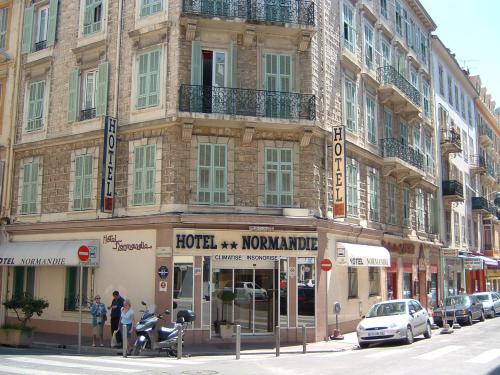
We stayed in Nice in the Hotel Normandie in double room that cost us $6.00. Just for the hell of it I googoled the place and you can see it pictured below. A double room this spring would cost $78. This is the only place in my journal that I give the name of the hotel and the price we paid so this is the only time I can make this comparison.

We took the bus along the coast to Monaco to see the Palace and watch the changing of the Palace Guard. It's quite a spectacle, as you can see in the picture below. We were astounded by the number of tourists who also were on hand to gawk at the sight. We also wandered around the streets, I don't mention whether in Nice or Monaco, but we stumbled upon an open air market, the first I'd ever seen, "which had everything - vegetables, meat, clothes, kitchen utensils, and fruit". We went to a waterfront dive for couscous in the North African style. In this case it didn't mean the just pasta, but the dish with lamb or seafood and peppers and couscous. I mention that we got thrown out of the casino for lack of proper attire. By thrown out, I mean we were asked to leave by a man in a tuxedo. We were still frustrated by the amount of money we were spending. I note that I'd cashed a ten dollar traveller's cheque in the morning and spent the entire amount before we even paid the hotel bill. Imagine! Ten dollars in one day! We should have stayed in Barcelona.

Mais, oui, Monaco est tres belle. But obviously we could not afford it. It was too rich for our blood. And I know at this point we were looking at our stash and wondering how long we could stay.

We took a bus the Maeght Foundation, this strange and wonderful museum and saw modern art. Matisse, Giacometti, Miro, Calder, Kandinsky, Picasso, they were all there. Some people have a little trouble appreciating modern art and make jokes about how long it would take a monkey to come up with the same quality of work, but we came away impressed. We had a good but expensive time in Southern France. But our Eurail Pass kept us on the move, and to avoid spending precious dollars on accommodations, we caught the night train to Rome.

Rome was to say the least, confusing. I can remember getting on a trolley car one evening trying to get to the Trevi Fountain after dinner. The information listed this trolley as going to the fountain so we hopped on. The conductor argued and he wouldn't take our money or let us sit down. Did it go the the Trevi Fountain? Si, si, signore. He was reluctant to let us ride but we were determined to take the trolley. He finally relented, we paid full fare, we sat down, the conductor sighed. The trolley went one block, switched onto a siding and went out of service for the night. The conductor shooed us off the trolley car, smiled and locked the doors as we walked off toward the fountain.

Rome was the oldest city either of us had ever been to, and while breathtakingly beautiful, we were not appreciating anything; we were probably showing signs of travel fatigue and homesickness. I remember almost everything in Rome began to piss me off. Wandering down old, ancient streets we noticed the walls about to crumble. Flying buttresses were constructed out of telephone poles to hold up walls. And the pole buttresses blocked off the streets, which were dirty and strewn with garbage. It wasn't charming, it was depressing.

Scott, being a good Irish boy, wanted to see the Vatican and so we ventured forth on April 14, 1972. We saw La Pieta, which is absolutely marvelous. You can't help looking at the marble and wondering how anyone could take cold stone, a chisel and a hammer and make folds of cloth look so soft and pliable. We climbed up into the cupola for a fantastic view. A view of what, I can't remember and my journal doesn't say. Was it a view of the interior of the Vatican or a view of the city of Rome? Or both? Does anyone know?
A little over a month later on May 21, a disturbed Lazlo Toth took a hammer to the foot and other sections of the sculpture. Pieces flew off and were snatched up as souvenirs, including Mary's nose. It had to be reconstructed from pieces of marble from the back of the sculpture. And now there is a fence around Michelangelo's masterpiece and you can't be as close as you would like.
We'd barely scratched the surface of things to see in Rome, but daylight was burnin', time was wastin' and our Eurail Pass was scorching our wallets. We packed up after two days in Rome and headed for Vienna where I had an old girlfriend and an even older cousin.
To Be Continued

 This lady was flattered to have me ask to take her picture. She spent some time adjusting her scarf on her head before smiling up at me. I think her strongly indigenous face and the woven goods behind her remind us that while the architecture may be Spanish Colonial, the people are Mexican. We had heard that there was a large gringo and foreign population in San Miguel; that may be true but it is still overwhelmingly indigenous.
 The sidewalk cafes under couverts remind one of the main plaza of Mirepoix (yes, France) n'est pas?
 The colonial Spanish who settled San Miguel seemed to have two main goals; convert the Indians to Catholicism, and remove all the gold to Spain. Consequently, churches in San Miguel are everywhere. In the historical downtown, there are no less that five magnificent churches. The gold went to Madrid.

 I'm not sure if this traditional dress is worn when they are not selling their goods, but nonetheless, it is very appealing. Native dress, sandals on bare feet and a plastic coke bottle. I am reminded of the traditional house dress worn by French women around Leran. The Mexican women have something similar, but it is a smock worn over other clothes.
 We stumbled upon this old gas pump, and I can remember these at gas stations when I was a kid, although the were brightly painted with the oil companies logo. Perhaps you can see that the guage is offering gas at 38 centavos per litre. My mind can't convert liters to gallons and old pesos to dollars, but that was probably a screamin' deal.
 Another reminder of Mirepoix, France. There always seems to be a guy caning chairs in the Monday morning market. This guy wasn't at a market but just sitting out on the street plying his trade.

 We stumbled upon a celebration of Cuban culture and dance. This grandmother was watching her grandchild and the dancing troupe at the same time.